On-Premise AI for Indian Manufacturers: What It Is, What It Costs and Where to Start
A practical guide to on-premise AI for Indian manufacturers: what it costs, how DPDP and data sovereignty shape the choice, and a 90-day pilot plan.
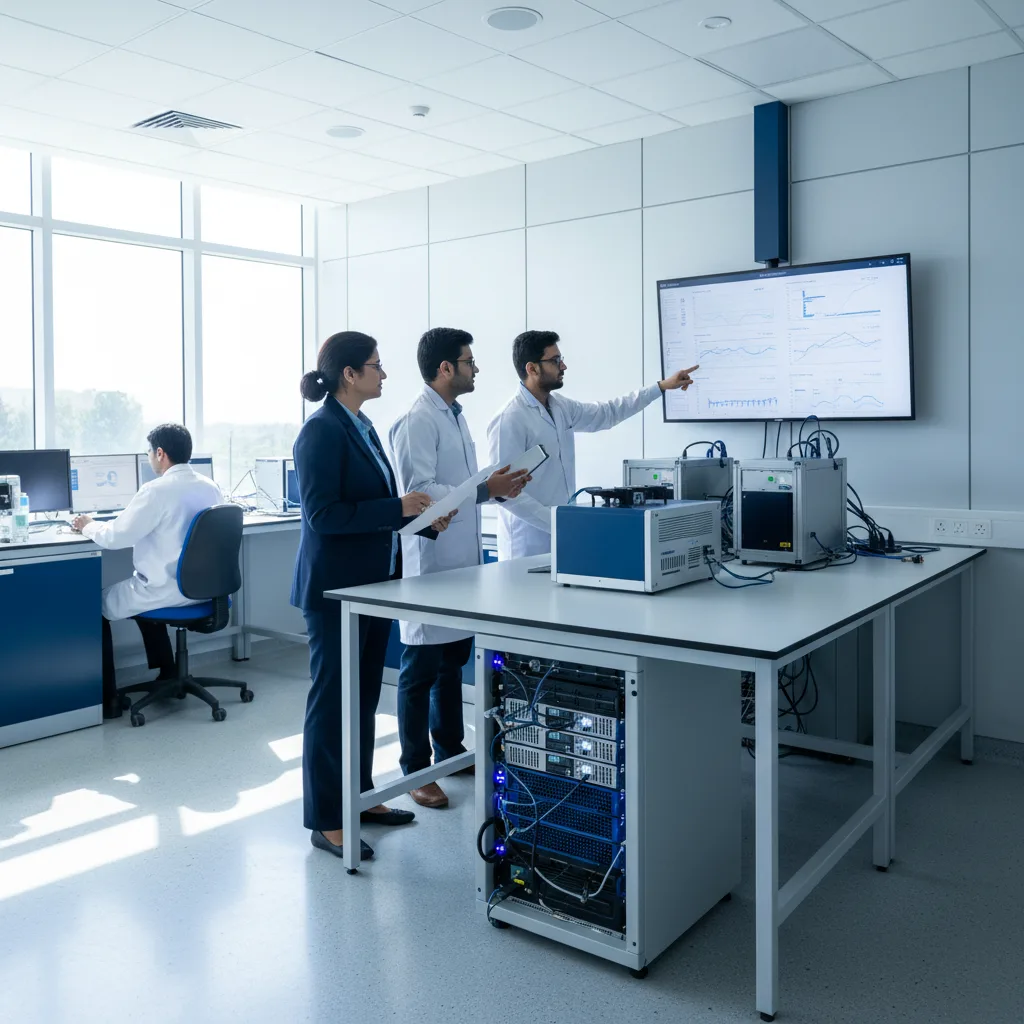
Most Indian plants sit on twenty years of hard-won knowledge — machine manuals, breakdown notes, batch records, SOP binders — locked in formats nobody can search. On-premise AI for Indian manufacturers exists to unlock exactly this: language models and document search running on servers inside your plant or data centre, so sensitive documents never leave your network. This guide covers what the technology is, what it realistically costs, how the DPDP Act and customer contracts shape the decision, and how to run a 90-day pilot that ends in a business case rather than a demo.
What On-Premise AI Actually Means (and What It Isn't)
In plain terms, it means a local LLM for enterprise use — a language model plus a retrieval layer (RAG on-premise) installed on hardware you own or control, inside your plant, your server room or an Indian data centre you contract directly. When an engineer asks a question, the system retrieves the relevant pages from your document store and the model writes an answer grounded in those pages, with citations. No document, query or answer travels to a third-party cloud.
Three building blocks do most of the work:
- Document intelligence and OCR. Indian factories and pharma plants hold decades of scanned registers, handwritten logbooks, vendor certificates and batch records, often in mixed English and regional-language text. Document intelligence with OCR built for Indian plant records turns that archive into searchable content — usually the single biggest effort in any project.
- A permission-aware enterprise knowledge assistant. Users ask questions in plain language and get answers citing the exact page, clause or SOP version. Permissions matter: a contract operator should not see what a quality head sees.
- SOP management software capabilities. Drafting support, version control and training help, so operators always work from the latest procedure rather than a printed copy from three years ago.
What it is not: a consumer chatbot. Private enterprise AI on your own hardware means you own the server, your IT team or a managed partner keeps it patched and running, and the models are typically smaller and tuned to your domain rather than the largest general-purpose systems. In exchange, you get full control over data, access and audit — a trade most regulated manufacturers consider fair.
The exchange is simple: you give up the convenience of someone else's cloud, and in return you get certainty about where your data sits and who can touch it.
Where It Pays Off: Shop Floor, Quality and Maintenance
AI for manufacturing in India pays off fastest where questions are frequent, documents are dense and time is expensive. Four patterns show up repeatedly:
- Maintenance and breakdowns. A fitter troubleshooting a failed drive can search ten years of machine manuals, work orders and breakdown notes in seconds instead of hunting through binders or waiting for the one senior engineer who remembers. On breakdown-critical lines, faster answers convert directly into uptime.
- Quality and compliance. Trace which SOP version was in force on a given date, pull batch-record context and reconstruct CAPA history. When an auditor or customer wants the procedure in effect and the deviation history, a cited answer beats a scramble through shared drives. For life sciences, this is where AI for pharma compliance earns its keep — retrieval with citations fits naturally with GxP traceability expectations.
- Shift handovers. AI-summarised handover notes carry recurring issues, pending actions and abnormal readings between shifts instead of letting them evaporate. Over months, the same data surfaces patterns — which machine, which line, which failure mode.
- Training and SOP adherence. New workers ramp faster when the assistant points to the exact clause and page instead of a 200-page manual. This is knowledge management for factories in its most practical form: less asking the old hand, more asking the system.
What It Costs: Hardware, Software and Hidden Line Items
Costs fall into three buckets: hardware, software and rollout, and the line items everyone forgets. Treat the numbers below as budgeting bands, not quotes — GPU pricing in India moves with supply, duties and exchange rates, so confirm current vendor pricing before committing.
| Tier | What it looks like | Indicative capex band | What changes |
|---|---|---|---|
| Single-GPU pilot server | One server in your server room or a co-location rack; one department or plant, roughly 20–50 concurrent users | Roughly ₹15–40 lakh all-in | Fastest to deploy; one use case; limited redundancy |
| Multi-GPU plant-wide setup | Dedicated AI servers, often two to four GPUs; several hundred users; monitoring and failover | Roughly ₹1–3 crore | Higher concurrency, faster OCR throughput; more power and cooling planning |
| Multi-site or HA cluster | Multiple nodes across sites or a private rack in an Indian data centre; disaster recovery and 24×7 operations | Project-scoped, several crore | Enterprise SLAs, central governance, cross-site search |
Software and rollout costs depend on the vendor's licensing model — per-server, per-user or perpetual — and on integration work. Budget for OCR effort on legacy archives (often the largest line), connectors to ERP, MES or QMS, and access-control mapping to your directory. A focused pilot typically lands in the 8–16 week range; plant-wide rollouts with integrations run six months to a year.
The forgotten costs are real: a loaded GPU server draws a kilowatt or more at the wall, so factor electricity, UPS capacity and cooling; someone must own patching, backups and model updates; and security reviews need calendar time. None of it is exotic, but it belongs in the business case.
The honest trade-off: cloud AI is genuinely cheaper when documents are low-sensitivity, teams are small and speed of experimentation matters more than control. On-premise AI in India becomes the defensible choice when the DPDP Act, GxP obligations, export-controlled work or customer NDAs make sending plant data to a third-party cloud hard to justify — or contractually impossible.
DPDP Act, Data Sovereignty and Customer Data Rules
Three forces push sensitive plant data toward on-premise deployment:
- The DPDP Act. India's Digital Personal Data Protection Act sets obligations for how personal data is secured, retained and accounted for. Plant data is full of personal data — operator names in logbooks, incident reports, training records — and DPDP Act AI compliance is easier to demonstrate when processing happens on infrastructure you control, with your own access logs and retention rules.
- Sector rules. Pharma and labs operate under GxP data-integrity expectations — attributable, legible, contemporaneous, original and accurate records with audit trails. Regulated supply contracts in automotive, aerospace and defence often prohibit sharing technical data with third-party processors at all.
- Customer NDAs. Many OEM and export contracts make uploading drawings, process parameters or quality data to a public AI service a breach, not merely a risk.
Data sovereignty for AI in India comes down to concrete questions: Where does the data physically sit? Who — including vendor personnel and sub-processors — can access it? Are there audit trails for every query and document change? Can deletion be guaranteed and verified? An Indian cloud region helps, but provider support access and sub-processor chains complicate the answer. On-premise gives you the shortest, most defensible reply: the data is on that server, in that room, and only these people can touch it.
Air-Gapped AI Deployment
Some sites — defence-linked work, export-controlled programmes, network-isolated plants — need air-gapped AI deployment with no internet dependency at all. It works. The costs are operational: model and security updates arrive through a controlled transfer process instead of a click, vendor remote support is limited, and cloud integrations are off the table. For most manufacturers, a standard on-premise deployment behind a firewall is enough; air-gapping is worth it only when the threat model genuinely demands it.
Vendor Due-Diligence Checklist
- Ask for a data flow diagram: does any component — telemetry, licence checks, update services — send anything outside your network?
- Confirm access logging: every query, document read and admin action, with exportable logs.
- Test model behaviour on your documents before buying; your scanned, handwritten, mixed-language records are the real benchmark.
- Clarify exit terms and vendor access: export format for your data, verified deletion, and who at the vendor can touch the system under what process.
Where to Start: Choosing Your First Use Case
Pick document-heavy, high-frequency pain. The three safest first candidates:
- Maintenance history search — manuals, work orders and breakdown notes.
- SOP lookup — the questions operators and supervisors already ask by walking to someone's desk.
- Quality and batch records — for pharma, labs and export-focused manufacturers where traceability queries are constant.
Start where answers are verifiable. An assistant that cites the exact page and clause builds trust fast — engineers check the source in seconds, quality leads validate against the master, and auditors see evidence rather than assertions.
Keep live production control and safety systems out of scope for the first phase. The assistant reads documents and drafts answers; it does not touch PLCs, SCADA or safety instrumented systems. That boundary keeps the pilot simple and the risk conversation short.
Design human approval gates from day one: AI drafts, humans decide — especially for SOP changes, deviation reports and any workflow action. This is also what makes the deployment defensible in an audit.
A 90-Day Pilot Plan (With Success Metrics)
- Days 1–30: set up. Pick one use case. Inventory the documents — formats, volumes, owners. Install the hardware and set the security baseline: network isolation, access controls mapped to your directory, logging switched on.
- Days 31–60: build and test. OCR the archive, build the knowledge base, and test with a small group of engineers, quality leads and operators. Fix citation accuracy and permission gaps weekly. Resist adding use cases mid-stream.
- Days 61–90: measure and decide. Capture time saved per query, answer accuracy as judged by your own experts, SOP compliance signals and adoption (weekly active users, queries per user). Compare against the baseline from week one, then make an explicit go/no-go on scaling.
Agree the metrics before day one. A pilot without pre-agreed success criteria produces a demo, not a decision.
Useful metrics to fix upfront: average minutes to answer today versus with the assistant; the share of answers your quality team verifies as correct and correctly cited; SOP lookups resolved without escalation; and adoption across the pilot group. Modest, honestly measured numbers make a stronger business case than an impressive demo.
Next Step
Shodh is a private, on-premise knowledge assistant built for this workflow: document intelligence tuned for Indian plant records, permission-aware answers with page-level citations, and deployment inside your own infrastructure — from a single pilot server to an air-gapped setup.
Request Shodh beta access to see private, on-premise AI answer questions from your own documents. Bring your toughest scanned logbook or SOP question to the first call.
Frequently Asked Questions
What is on-premise AI for manufacturers?
It is a language model and retrieval system running on servers inside your plant or data centre. It answers questions from your own documents — manuals, SOPs, batch records — with citations to the source page, and no data leaves your network. It is a knowledge and search layer, not a production control system.
How much does on-premise AI cost in India?
Budget roughly ₹15–40 lakh in capex for a single-GPU pilot server and roughly ₹1–3 crore for a plant-wide multi-GPU setup, plus software licensing, OCR effort and integration work. Add recurring costs for power, cooling, IT administration and updates. GPU pricing moves with supply and duties, so treat these as planning bands and get current quotes.
Is on-premise AI required for DPDP Act compliance?
No — the DPDP Act does not mandate on-premise infrastructure. But processing personal data on systems you control, with your own access logs and retention rules, makes the security-safeguard and accountability obligations far easier to demonstrate, especially alongside GxP or NDA constraints.
Can an on-premise LLM work without internet access?
Yes. A fully air-gapped deployment runs the model, retrieval and OCR entirely offline. You trade convenience: updates arrive through a controlled transfer process, vendor remote support is limited, and cloud integrations are unavailable.
How is on-premise AI different from cloud AI?
On-premise keeps data, queries and answers on your hardware — you control access, audit trails and residency, and you carry the capex and operations responsibility. Cloud AI offers faster setup, larger models and pay-as-you-go pricing, but your documents pass through a third party. For sensitive plant data, that difference is decisive.
Keep reading

Cloud Repatriation for AI in India: Which Workloads to Move On-Premise and How to Decide
A practical guide for Indian manufacturers, pharma, logistics and public-sector teams on which AI workloads to move on-premise — and how to decide.

83% of Enterprises Are Repatriating AI Workloads: What It Means for On-Premise AI in India
Broadcom found 83% of enterprises plan to repatriate AI workloads. What that shift means for on-premise AI in India: costs, DPDP, and a pilot playbook.

From Data Localisation to AI Localisation: How Indian Enterprises Can Run AI Inference On-Premise for DPDP Compliance
Why Indian enterprises must localise AI processing, not just data storage, for DPDP compliance — and how on-premise AI inference delivers it.