Cloud Repatriation for AI in India: Which Workloads to Move On-Premise and How to Decide
A practical guide for Indian manufacturers, pharma, logistics and public-sector teams on which AI workloads to move on-premise — and how to decide.
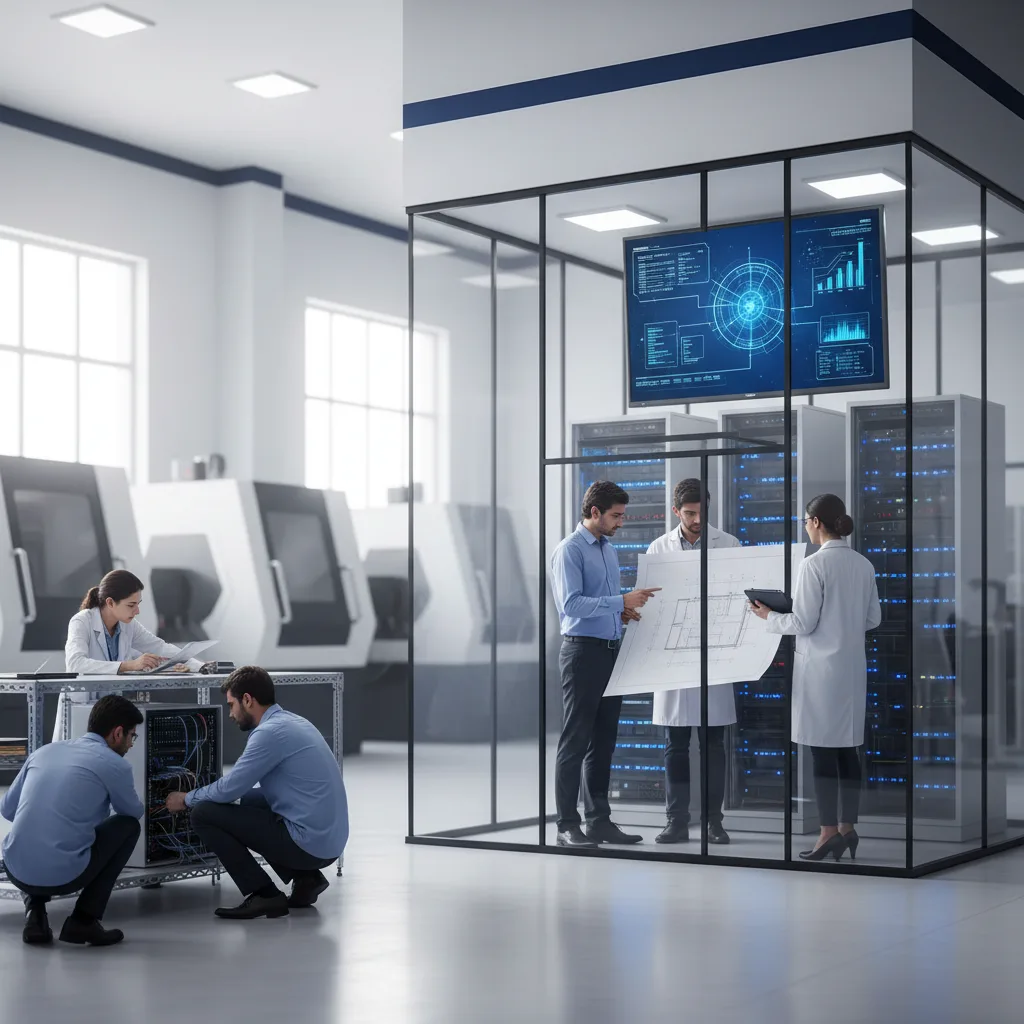
Somewhere between the third month of per-token API bills and the first auditor question about where your batch records actually live, most Indian enterprises arrive at the same question: why is our AI running in someone else's data centre? Cloud repatriation for AI in India has moved from fringe idea to boardroom agenda, driven by cost curves, the DPDP Act, and the plain fact that plants and warehouses need answers even when the WAN link is not cooperating. This article sets out which AI workloads are worth bringing back on-premise, which should stay in the cloud, and a 90-day plan for your first move.
Why Indian Enterprises Are Pulling AI Workloads Back On-Premise
The push back on-premise is not nostalgia for the data-centre era. It is four pressures converging at once.
Cloud AI economics stop scaling
Per-token inference fees look harmless in a pilot. They stop looking harmless when document intelligence runs over lakhs of scanned pages a month, or when a few thousand employees start asking an assistant daily questions. Add GPU premiums and egress charges — billed every time documents move out for processing — and the unit economics of private enterprise AI in the cloud get worse with volume instead of better.
Regulation rewards keeping data close
The DPDP Act imposes notice, consent, purpose-limitation and security duties the moment your AI touches personal data. Pharma carries GxP expectations around record integrity and audit trails. CERT-In directions shape logging and incident-reporting practice. Public-sector contracts increasingly carry data localisation expectations. None of these individually forces on-premise AI in India — but every one of them becomes easier to evidence when the data never leaves your servers.
Operations cannot depend on cloud uptime
A knowledge assistant is only useful if it answers during the night shift. Plant-floor and warehouse AI has to work when the internet link is slow, metered or down. An on-premise deployment keeps working when the WAN does not.
Boards treat documents as core IP
SOPs, batch records, vendor contracts and pricing notes are the crown jewels of most Indian manufacturers. Many boards will not place them on third-party infrastructure, whatever the contracts say. That is a legitimate position, and increasingly a written one in AI governance policies.
How to Decide: A Workload Triage Framework for AI Repatriation
Repatriation is not all-or-nothing. Score each AI workload on five criteria before deciding where it runs:
- Data sensitivity — does it touch personal data, GxP records, pricing or unreleased IP?
- Regulatory exposure — would an auditor ask where this data lives and who accessed it?
- Latency needs — must answers arrive in seconds on the shop floor, or is overnight good enough?
- Steady-state volume — is usage continuous and predictable, or bursty and rare?
- Audit requirements — do you need cited answers, version history and human approval gates?
Strong repatriation candidates score high on most of these: high-volume document intelligence and OCR, internal enterprise knowledge assistants over confidential corpora, and SOP drafting with versioning.
Weak candidates score low: bursty fine-tuning runs, experiments on public data, and public-facing content generation. These rarely justify dedicated hardware and migration effort.
The sensible default is hybrid. Keep sensitive inference and storage on-premise, and burst non-sensitive compute to the cloud only when it is genuinely cheaper — for instance, a one-off fine-tuning run that would otherwise leave your GPUs idle for eleven months of the year.
Which AI Workloads Belong On-Premise in Indian Industry
The best first candidates share a pattern: confidential documents, steady volume, and a need for answers with citations.
Manufacturing
AI for manufacturing in India starts with paper. Inspection reports, maintenance logs and shift handover notes arrive as scans, photos and handwritten sheets. Document intelligence and OCR over these — run fully local — gives maintenance and quality teams operational intelligence they have never had: what happened on this line, what the last three shifts did about it, and which SOP clause applies, answered in seconds with a citation.
This is knowledge management for factories in its most practical form: the assistant reads the messy records you already generate, and the answers stay inside the plant network.
Pharma and labs
Permission-aware knowledge assistants that answer with citations from GxP documents are the flagship use case for AI in pharma compliance. The answer must point to the exact clause in the exact version of the exact document — anything less will not survive an inspection. Alongside sits SOP management software: drafting, versioning, training records and audit trails, with human approval gates before anything becomes official.
Logistics and warehousing
Extraction from GRNs, PODs and invoices; exception handling; and shift handover summaries. AI for logistics operations in India pays off precisely where documents arrive as poor scans in dozens of formats and turnaround commitments are measured in hours. Running this on-premise removes per-consignment egress costs and keeps customer data inside your perimeter.
Infrastructure and public bodies
Tender and contract intelligence, compliance records, and air-gapped AI deployment where connectivity is restricted or data rules are strict. For many public-sector and infrastructure contexts, a fully local setup is the only architecture procurement will sign off on.
What Can Reasonably Stay in the Cloud
Not everything deserves a server. Three categories are usually better left where they are:
- Spiky, one-off compute. Large fine-tuning runs, benchmarking and seasonal analytics bursts that would leave your own GPUs idle most of the year. Renting briefly beats owning permanently.
- Non-sensitive workloads on public data. Marketing content and general research assistants that never touch proprietary records carry little regulatory or IP risk.
- SaaS tools with no confidential documents in scope. Repatriating them adds ops burden without reducing risk.
Rule of thumb: if a breach or an egress bill would hurt more than the migration effort, repatriate. Otherwise, stay put.
The Cost Reality: On-Premise AI TCO vs Cloud AI in India
On-premise cost lines are GPU server capex, power and cooling, rack space, and ops time. A single-GPU node is a realistic entry point — enough to run a local LLM for enterprise queries with RAG on-premise at department scale.
Cloud cost lines are per-token inference, GPU hours, storage and egress. They are predictable at pilot scale and painful at production volume, because every scanned page and every query bills.
| Cost line | On-premise | Cloud |
|---|---|---|
| Compute | GPU capex, depreciated over three to five years | Per-token fees or GPU hours, billed for as long as you run |
| Documents and storage | Your existing storage; no per-GB movement charges | Storage fees plus egress every time data moves |
| Power, cooling, rack space | Recurring opex you own | Bundled into unit prices |
| Operations and talent | One trained engineer can cover a small estate | Vendor-managed, but integration work stays yours |
| Cost behaviour | Fixed and predictable; improves with volume | Linear with usage; spikes at production scale |
The break-even pattern is consistent: steady, high-volume inference — OCR over scanned records, RAG queries from a few thousand employees — commonly favours on-premise within roughly 12 to 24 months. Bursty, low-utilisation workloads almost never do.
Hidden costs exist on both sides: integration with your DMS, ERP or MES; model updates; security hardening; and talent. Budget for them explicitly rather than discovering them in month four.
Compliance and Data Sovereignty: DPDP Act, GxP and Air-Gapped AI
In plain terms, the DPDP Act applies when your AI touches personal data in your records — employee names in shift logs, consignee details in PODs, patient identifiers in lab reports. The duties are notice, consent, purpose limitation and reasonable security safeguards. The Act does not mandate on-premise deployment, but keeping personal data on servers you control makes purpose limitation and access control far easier to demonstrate. That is why data sovereignty has become the language boards use for this decision.
Sector overlays often matter more than the Act itself: GxP audit trails in pharma, CERT-In logging and incident-reporting directions, and data localisation clauses in public-sector contracts. Design your AI architecture against the strictest overlay that applies to the documents it reads.
Air-gapped versus connected on-premise
Full air-gapped AI deployment is warranted when a site has restricted connectivity or the contract demands it — certain public bodies, defence-adjacent infrastructure, some pharma quality environments. The trade-off is real: no external API calls, no vendor telemetry, and model updates become planned manual events rather than automatic ones. A connected on-premise deployment gives you most of the control with less friction; choose full isolation only when it is actually required.
The evidence auditors actually ask for
- Cited answers that point to the source document and its version
- Document version history showing what changed and when
- Permission logs showing who asked what, and what they were allowed to see
- Human approval gates before AI-drafted content enters official records
A 90-Day Plan to Repatriate Your First AI Workload
Pick one workload and prove it. Ninety days is enough if you stay narrow.
- Days 1–30: choose one measurable workload. Document intelligence over scanned records is the usual first pick. Baseline the current cost per document, turnaround time and error rate — you cannot prove savings without a baseline.
- Days 31–60: deploy and wire the guardrails. Run a local LLM with RAG on a single GPU node. Map permissions to your existing access model, force citations on every answer, and put human approval gates before anything enters official records. Run in parallel with the existing process, never instead of it.
- Days 61–90: measure and decide. Compare accuracy, time saved and cost per document against the baseline. Get quality and compliance sign-off. Then choose the scale-up sequence: more document types, more departments, or a second node.
The output of the pilot should be evidence, not enthusiasm: a cost-per-document number, an accuracy figure, and a compliance sign-off you can take to the board.
The next step is to request beta access and run this pilot on your own servers, with your own data, under your own permission model. Request Shodh beta access to see private, on-premise AI answer questions from your own documents — with citations your quality, compliance and IT teams can verify end to end.
Frequently Asked Questions
What is cloud repatriation in AI?
Cloud repatriation in AI means moving AI workloads — inference, document processing, storage and retrieval — off public cloud platforms and onto infrastructure you control, such as your own data centre or a colocation facility. For Indian enterprises it usually means running a local LLM with RAG over confidential documents on-premise, while keeping non-sensitive or bursty workloads in the cloud.
Which AI workloads should run on-premise?
Strong candidates are high-volume document intelligence and OCR over confidential records, internal knowledge assistants over SOPs, batch records and contracts, and any workload with personal data, GxP exposure or strict audit requirements. Weak candidates are bursty fine-tuning runs, experiments on public data and public-facing content generation.
Is on-premise AI cheaper than cloud AI?
It depends on volume. Steady, high-volume inference such as OCR and RAG queries commonly breaks even against cloud within roughly 12 to 24 months, after which on-premise is clearly cheaper. Spiky, low-utilisation workloads are usually cheaper in the cloud because you avoid paying for GPUs that sit idle most of the year.
Does the DPDP Act require AI to run on-premise?
No. The DPDP Act sets duties — notice, consent, purpose limitation and security safeguards — but does not dictate where systems run. On-premise deployment simply makes it easier to demonstrate control over personal data. Sector-specific rules and public-sector contracts may impose localisation requirements that effectively demand it.
Can you run a local LLM with RAG fully on-premise?
Yes. Open-weight models, embedding models, vector stores and OCR can all run on a single GPU node inside your network, with no external API calls. Air-gapped deployments are also feasible; the trade-off is that model updates become planned manual events rather than automatic ones.
Keep reading
Air-Gapped AI Deployment in India: A Practical Guide for Pharma, Manufacturing and Other Regulated Workloads
Air-gapped AI for Indian pharma, manufacturing and logistics: isolation tiers, DPDP and GxP drivers, stack components, costs and a 90-day pilot plan.

Google Brings Air-Gapped Gemini to India: What Regulated Enterprises Should Weigh Before Choosing Private AI
Google's air-gapped Gemini makes private AI mainstream in India. Here is how air-gapped cloud differs from on-premise AI on custody, compliance and cost.

RAG vs. AI Agents: What Indian Manufacturers Should Build First for On-Premise Knowledge Automation
RAG retrieves answers from your own documents; AI agents take actions. Here's which one Indian manufacturers should build first on-premise.